

A Practical Guide to Camlock Hose Couplings
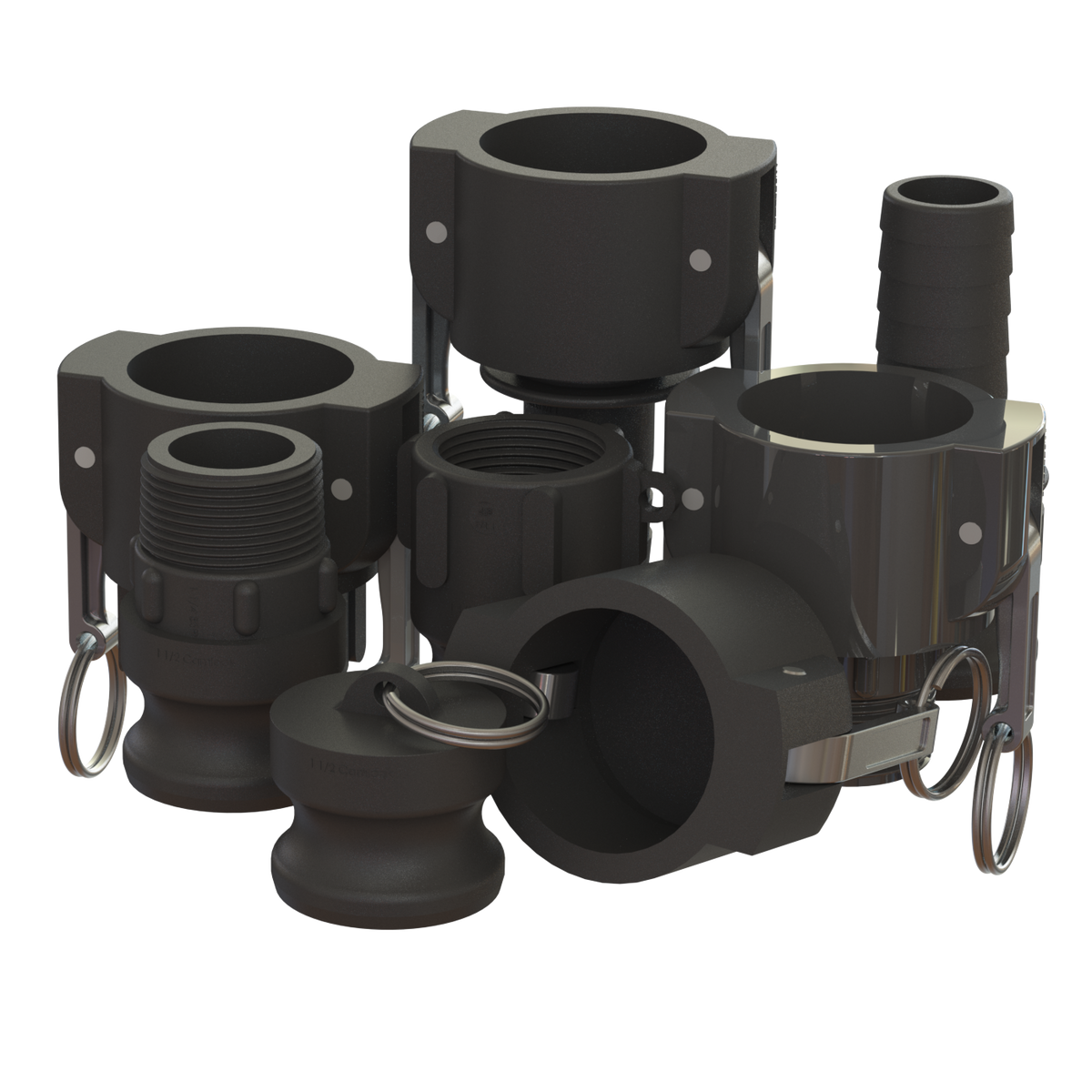
Camlock couplings provide a quick way to connect and disconnect hoses and pipework without repeatedly screwing threaded fittings together. They are widely used in industrial liquid transfer because the connection is simple, fast and available in many end configurations.
How a Camlock connection works
A male Camlock adaptor fits into a female coupler. The two cam arms on the female side rotate into the groove on the male adaptor and draw the two halves together against the gasket.
The Regular 8 types
- Type A: male Camlock × female thread
- Type B: female Camlock × male thread
- Type C: female Camlock × hose tail
- Type D: female Camlock × female thread
- Type E: male Camlock × hose tail
- Type F: male Camlock × male thread
- Type DC: female dust cap
- Type DP: male dust plug
CPP® materials and standards
CPP® Regular 8 bodies are moulded in glass-filled polypropylene. Female couplers and caps use 304 stainless-steel arms, pins and rings, with PP Olefin Elastomer gaskets. The range is designed around Camlock dimensions used by EN 14420-7 and A-A-59326.
BSPP, BSPT and NPT are not interchangeable
CPP® uses BSPT for tapered male BSP threads and BSPP for parallel female BSP threads in the Regular 8 range. NPT is a separate tapered US pipe-thread standard. Always check both the Camlock head size and the thread or hose-tail size.
Pressure depends on size and temperature
CPP® publishes water-service guidance by Camlock size and temperature rather than one rating for the whole range. The complete installation is always limited by its lowest-rated component, including the hose, clamps, valves and connected equipment.
Check the CPP® Camlock size chart →
Need help with an IBC, Camlock or fluid-transfer connection? Ask CPP® Technical Support or contact CPP®.